Signed in as:
filler@godaddy.com
This page maps the central concepts in my work: a connected account of how moral systems close. It traces how shared conviction forms without anyone being persuaded, how it hardens into something that cannot be questioned from within, how it comes to treat agreement as the only evidence of understanding, and what this does to the people living inside it.
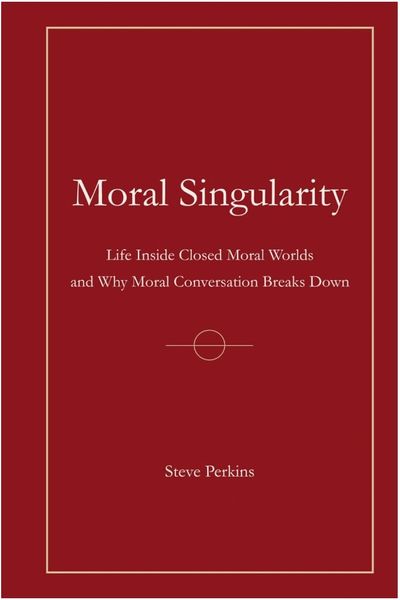
The framework is set out in full in my book, Moral Singularity: Life Inside Closed Moral Worlds and Why Moral Conversation Breaks Down (Whitestone Editions, 2026), and has been extended in the essays that have continued the work since.
The concepts are arranged in the order the argument unfolds, so that reading from the top is a way of following the structure as a whole rather than looking up terms one at a time. Each is a component of a single framework, and their meanings depend on their position within it.
The Spark of Harm
The system begins with a legitimate, sincere effort to address real-world harm.
The Trap of Urgency
As the issue feels more urgent, the perceived cost of waiting or deliberating spikes. Reflection begins to look like complicity, evasion, or intentional delay.
The Demand for Agreement
Because action is treated as immediate, deep understanding is sacrificed for fast compliance. Agreement is increasingly treated as evidence of understanding.
Systemic Stabilisation
The system builds its own immune response. It develops internal criteria for what counts as legitimate evidence, legitimate concern, and legitimate objection, ensuring that outside challenges can no longer reach it as correction.
Epistemic Inversion
Epistemic inversion is the reversal of how a community establishes truth or facts. In a normal truth-seeking framework, evidence leads to conclusions. In a state of epistemic inversion, ideological alignment determines the validity of the evidence. If an outside fact threatens the framework’s moral goal, the framework dictates that the fact must be malicious, manufactured, or structurally blind.
The Collapse of Conversational Space
Once disagreement is reclassified before it can be heard, the standard tools of intellectual disagreement - nuance, evidence, logic, hesitation, and good-faith objection - stop functioning in the ordinary way.
Moral Ecology
Moral ecology is morality understood not as a set of individual beliefs but as an environment, a field that conditions what can be expressed, recognised, and sustained within it.
The framework begins by relocating morality from inside the individual to the environment around them. A moral ecology is the surrounding field - the platforms, institutions, and shared expectations - that determines which moral signals are visible, which are rewarded, and which become impossible to sustain. This is crucial because it means moral closure is not primarily a failure of individual character or reasoning but a property of environments. People of entirely good faith, thinking as carefully as they can, will tend toward closure if the ecology around them selects for it. Almost everything else in the framework follows from taking the environment, rather than the individual, as the unit of analysis. The opening move of Moral Singularity.
Tempo
Tempo is temporal compression treated as a structural force: the degree to which moral life is conducted too fast to permit the slowness that reflection and revision require.
Closure needs speed. The hesitation in which a person might notice that a position does not quite fit, that an objection has merit, that a situation is more complex than the framework allows, is precisely the hesitation that compressed time removes. Tempo is not a mood or a complaint about modern busyness. It is a causal structural force that reshapes judgement, revisability, and legitimacy by reducing the time available for any of them. As tempo rises, snap judgement displaces deliberation, and the displacement is experienced not as loss but as responsiveness. Developed in Moral Singularity.
Moral Urgency
Moral urgency is the ambient atmosphere of emergency that moralises delay itself, converting speed of response into a measure of seriousness or virtue.
Where tempo is the structural compression of time, moral urgency is its felt moral charge. It is the pervasive sense, detached from any specific crisis, that to pause, to weigh, to withhold judgement is itself a kind of moral failure, a sign that one does not care enough or grasp the stakes. Under moral urgency, the person who hesitates is suspected, and the person who responds immediately is credited with seriousness, regardless of whether the immediate response was right. This is one of the conditions that lets conviction spread before it can be examined, because there is never quite time to think, and the not-thinking feels like conscience. Developed in Moral Singularity.
Conviction Cascades
A conviction cascade is the amplification of confidence through repetition and legibility rather than through inquiry: the process by which people come to hold positions they were never actually persuaded of.
We tend to assume beliefs spread by persuasion or by pressure. A conviction cascade is neither. A position travels through a profession or a social world because it is easy to carry, signals belonging, and asks nobody to slow down, until holding it feels indistinguishable from having reasoned one's way to it. This differs from the more familiar idea of preference falsification, which assumes people privately disagree and outwardly conform. In a cascade there is often no private disagreement at all, because the position was taken up before it was ever examined. What spreads is not a suppressed truth waiting to surface but an unexamined ease. Confidence rises through repetition and social proof, and the rising confidence is mistaken for the accumulation of evidence. Developed in the essay Conviction Cascades and in Moral Singularity.
Legibility
Legibility is the quality that makes a moral position easy to recognise, repeat, and be seen holding, and it is what determines which positions travel rather than which are true.
Some positions are simply easier to carry than others: morally clear, emotionally unambiguous, requiring no uncomfortable distinctions. Legibility is that quality of easy uptake, and it is the engine inside a conviction cascade. In any environment operating under compressed time and limited attention, the positions that spread are not the most accurate but the most legible, the ones that can be picked up quickly, displayed without risk, and recognised by others as the mark of a sound person. Legibility explains why, under pressure, belief tracks what is easiest to hold rather than what is most defensible. Developed across the essays as a recurring mechanism within the Moral Singularity framework.
Epistemic Inversion
Epistemic inversion is the reversal whereby alignment comes to function as evidence of understanding, so that agreement is taken as comprehension and disagreement as a failure to comprehend. Epistemic inversion is the reversal of truth-seeking. In an open system, evidence leads to conclusions. In a closed system, alignment decides which evidence is allowed to count.
Most people have met this without having a name for it: you raise an objection and, instead of being answered, you are told you have not understood, that if you truly grasped the matter you would not be objecting. In an open system, understanding and agreement are separable; a person can grasp a position completely and still reject it. Epistemic inversion is the collapse of that separation. Assent becomes the only recognised sign of comprehension, and dissent is reread as ignorance or bad faith. This is what makes a closing system so hard to argue with from inside, because every objection is automatically converted into evidence of the very confusion the system exists to cure. It is among the deepest mechanisms of closure, because over time it degrades something more than debate: it erodes the capacity to learn from reality at all, since reality can no longer get in if it arrives in the form of disagreement. The result is a gradual thinning of the terrain from which judgement can be informed, narrowing the range of responses available to both individuals and institutions. Developed in Moral Singularity and across subsequent essays.
Authority Without Argument
Authority without argument is the stabilisation of a position's authority through alignment and the ordinary friction of social life, rather than through persuasion.
Once a position has spread widely enough through a moral ecology, it no longer needs to win arguments. Its authority comes from its settledness, from the fact that everyone who matters already holds it, and persuasion becomes unnecessary. The position is no longer argued for; it is simply assumed, and the assumption is enforced by the accumulated weight of everyone around you treating it as obvious rather than sanction. To question it is not to lose an argument but to mark yourself as outside the consensus. Developed in Moral Singularity.
Enforcement Without Intention
Enforcement without intention is the way a closed system maintains itself through ordinary interactional friction and redirection, rather than through deliberate sanction.
No one needs to decide to police a closed moral system. It polices itself through the small movements of everyday interaction: the slight cooling when something off-key is said, the change of subject, the pause, the redirection, the warmth that arrives for the aligned comment and withdraws from the discordant one. None of this is intended as enforcement, and those doing it would be surprised to hear it described that way. But its effect is enforcement all the same, and its lack of intention is exactly what makes it so difficult to name or resist. Developed in Moral Singularity.
The Interpretive Ratchet
An interpretive ratchet is a framework that can only tighten: agreement confirms it, disagreement confirms the need for it, and no input loosens it.
A ratchet allows movement in one direction only. An interpretive ratchet is a system of thought constructed so that every possible response feeds its advance. Acceptance is taken as validation; resistance is taken as proof that the framework is needed all the more. There is no observation and no argument that can count against it, because it has already assigned a meaning to disagreement before the disagreement is heard. This is how a perspective that began as one position among many hardens, over time, into a condition of competence rather than a claim that must be argued for. The ratchet is the form moral closure takes when it becomes embedded in an institution's rules. Introduced in the essay The Interpretive Ratchet, extending the closure mechanisms of Moral Singularity.
Moral Singularity
A moral singularity is the completed closure state of a moral system: the point at which internal validation becomes sufficient and external correction loses standing, so that from inside, the moral language of those outside no longer makes sense.
This is the state the other concepts build toward. A moral singularity is what remains once conviction cascades have stabilised through authority without argument, and epistemic inversion has removed the capacity to tell understanding from agreement. Inside it, the system's own terms feel like simple moral reality rather than one interpretation among others. The language of outsiders does not register as disagreement to be weighed but as confusion, harm, or bad faith. The system has become unanswerable not because it has won the argument but because it has lost the ability to recognise that an argument is being had. It is self-validating and self-sealing: correction from outside no longer has any way in. The central concept of Moral Singularity.
Closed Moral Systems
Closed moral systems are moral systems that have become self-sealing through internal validation, reclassifying disagreement rather than integrating it. A closed moral system builds its own immune response. It decides in advance what counts as legitimate evidence, legitimate concern, and legitimate objection. The framework cannot be pierced because every challenge is processed by the framework itself.
Where moral singularity names the threshold state, closed moral systems names the general phenomenon. Such a system does not respond to challenge by weighing it. It responds by reclassifying it: the challenge becomes a symptom, a harm, a failure of understanding, a mark of bad character. Whatever cannot be absorbed is relabelled as something the system already has a category for, so that nothing genuinely external ever reaches it. This reclassification is the mechanism of self-sealing, and it can operate without anyone intending it and while everyone involved acts in complete good faith.
Developed throughout Moral Singularity.
This is the inward dimension of the framework. The concepts above describe how systems close. This describes what closure does to the person living inside it.
Inner Ontological Flattening
Inner ontological flattening is the narrowing of a person's inner world that occurs when they live long enough inside a closed system: the gradual loss of access to feelings, perceptions, and parts of the self that the system has no category for.
A closed system does not only constrain what can be said. Over time it reshapes what can be experienced. The responses the environment has no place for - the doubt, the unease, the perception that does not fit, the part of the self that does not align - grow harder to reach, not because they are forbidden but because there is no longer any internal room for them. The person becomes flatter, more aligned, more legible to the system and less legible to themselves. The loss is rarely dramatic and rarely noticed as it happens, which is part of what makes it serious. People can lose access to whole dimensions of their own response and experience the loss as clarity, as peace, or as finally belonging. It is the most intimate cost of closure and the hardest to see from inside, because the faculty that would notice it is the faculty being flattened. Developed in Moral Singularity.
Therapeutic Enclosure
Therapeutic enclosure is the way the language of care and protection can function as containment without any coercive intent: the structural contraction of a person's interpretive space around a framework, often without either party noticing.
This is what closure looks like in the specific setting of therapy, and more widely wherever care is the organising language. The consulting room is meant to be a place where a person can think freely, including in directions the therapist would not choose. Therapeutic enclosure is the narrowing of that freedom, as the client learns, without being told, which interpretations are welcome and which are met with silence, and begins to understand their own experience in the therapist's terms. It involves no coercion. It works through attention, warmth, and emphasis, through what is met with interest and what is passed over ( client impact explored here, institutional instance explored here, and here). Disagreement is reclassified as harm, resistance as something to be worked through. The danger is greatest precisely because no one intends it, and because it arrives wearing the language of care.
A core concept of Moral Singularity, developed further across subsequent essays.
The Right Not to Be Interpreted
The right not to be interpreted is the ethical principle that a person is entitled to speak, hesitate, and remain unexplained for as long as they need, before any framework is applied to them.
This is the stance that follows from recognising therapeutic enclosure. If interpretation can narrow a person's world without anyone intending it, then restraint becomes an ethical requirement rather than a failure of engagement. Some experiences need company before they need meaning. The principle holds that there are moments when the most respectful thing a therapist, or anyone, can do is to withhold the interpretation, resist the urge to explain a person to themselves, and let them remain uninterpreted long enough to find out what is true on their own terms. Developed in the essay The Right Not to Be Interpreted.
The Reflective Firewall
The reflective firewall is the fragile set of conditions - of time, language, and trust - that must hold for reflection to remain possible at all under closure.
If closure is the degradation of the capacity to think against one's environment, the reflective firewall names what protects that capacity while it survives. It is the protected tempo, the available language, the relationships of trust in which unfinished thought is still permitted, where a person can doubt aloud without immediate penalty and hold a question open without being made to resolve it. The firewall is fragile because all of its conditions are exactly the things that closure erodes: it compresses the time, narrows the language, and penalises the doubt. Naming the firewall is a way of naming what has to be defended if reflection is to remain possible. Developed in Moral Singularity.
Limits of Repair
Limits of repair is the recognition that there is a point beyond which talk of remedy or solution becomes structurally impossible, not merely difficult.
The framework offers no programme of repair, and this is deliberate rather than evasive. Once a system has fully closed, the very language of solution gets absorbed into the closure, reinterpreted in the system's own terms, and turned into one more confirmation of the framework. To propose a remedy is to offer something the system will simply reclassify. The limits of repair are structural, not motivational: they are not about anyone lacking the will to fix things, but about the point past which the tools of repair no longer have any purchase. This is why the framework stops where it does, describing the structure without prescribing a cure it does not believe can be cleanly applied. Developed in Moral Singularity, particularly its closing chapters.
These are newer ideas, emerging from the most recent essays. They recur often enough to be worth naming, but they are still settling and have not yet taken final form. They are gathered here as the growing edge of the framework.
The Refusal to Rank
The refusal to rank is the now-reflexive sense, woven deep into professional life, that to judge between competing forms - to say that one culture, one choice, one way of living might be better than another - is itself a kind of bigotry.
Most people have felt this without naming it: the small chill in a room when someone makes a straightforward qualitative judgement, the speed with which "who are we to say" arrives to end the conversation. Tolerance once meant the willingness to live alongside what you had judged and found wanting. In its inverted form it has come to mean the prohibition of judgement itself, so that ranking, weighing, or discriminating between things is treated as inherently suspect. A culture organised around the refusal to rank cannot correct itself, because correction is an act of judgement, and judgement is the thing it has forbidden. Introduced in the essay The Starmer Problem.
The Managerial Kit
The managerial kit, or simply the kit, is the portable set of legible good-person positions that a professional or managerial class carries as the markers of belonging, held not as convictions earned through difficulty but as the surface signals that one is sound.
Anyone who has moved through institutional life recognises the kit, even without naming it: the cluster of correct positions everyone in the room is assumed to hold, the ones you signal early so that you are read as safe before you say anything complicated. The kit is carried rather than reasoned toward. Because it was never argued for, it cannot be argued with; and because it functions as a badge of membership rather than a tool for understanding the world, it cannot be adjusted when the world stops matching it. Those who hold it can only display it more insistently as it fails them. Introduced in the essay The Starmer Problem.
---
The fullest account of the framework, including its sequential architecture and the structural threshold at which closure becomes self-sustaining, is in Moral Singularity: Life Inside Closed Moral Worlds and Why Moral Conversation Breaks Down (Whitestone Editions, 2026). The essays continue to develop it, applying it to clinical practice, professional culture, and public life. Concepts are added to this page as they earn their place.