Signed in as:
filler@godaddy.com
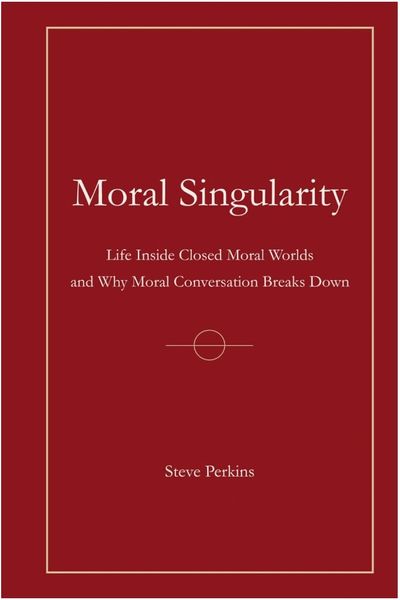
Moral Singularity: Life Inside Closed Moral Worlds and Why Moral Conversation Breaks Down
Author: Steve Perkins
You will probably have noticed some version of it. Conversations that used to be possible have become strangely difficult, and institutions now speak a language that sounds caring and responsible while feeling a long way from the thing being described. Political leaders give fluent answers that leave the question untouched. Professional life carries a constant hum of urgency without anyone quite able to say what the emergency is.
And disagreement has changed, because being wrong is no longer the only possibility on offer. To disagree can now mean that you have failed to understand, or failed to care, or given something away about yourself.
Moral Singularity came out of trying to understand what was happening in situations like these.
Moral systems can close. A set of beliefs can become so convincing from the inside that evidence from outside loses its ordinary force, so that what fits is absorbed easily while what doesn't is discounted, explained away, or turned into further evidence for the framework itself.
None of this needs bad people, or stupid ones, or anybody conspiring, because closure can grow out of things we would usually call virtues: care for others, urgency about real harm, the wish to act responsibly, and the entirely understandable desire to be standing on the right side of something that feels morally important.
The difficulty is that a closed system does not feel closed from inside. It feels coherent, serious and morally alert. By the time the closure becomes obvious from outside, disagreement and contrary evidence may already have lost much of their power to change anything.
The book describes how that happens, how a system reaches that point, and describes the cost to people living inside one, in public life, in institutions, in the consulting room, and in a person's own head.
I don't offer a programme for fixing it. The book explains why I doubt there is an easy fix. Getting the description right seemed the first task.
Most explanations of our present difficulty start with what people believe: left and right, ideology, misinformation, values, competing moral priorities. I became interested in something else, which was what was happening around those beliefs as they formed.
What happens when everybody feels they have to reach a position quickly, or when one answer is much easier to say out loud than another? What happens when agreement brings approval while hesitation attracts suspicion, and those conditions stay in place for years rather than weeks?
Leave them there long enough and they begin to shape what people notice, what sounds plausible, which doubts get voiced, and which objections people feel able to raise.
That's where moral closure begins.

The framework grew mainly out of my work as a psychotherapist and supervisor.
Therapy is an unusual vantage point, because you spend years listening to people trying to work out what they actually think and feel, often while family, work, institutions and the wider culture are also offering explanations for what they are experiencing. Supervision gives you a second view of the same process, through the work of other therapists.
Then I began noticing versions of the same thing elsewhere: in professional bodies, politics, activist movements, religious groups and organisations built around care. The beliefs could be completely different, sometimes politically opposed, and yet the way certainty formed and then defended itself looked oddly familiar.
That is why I don't think closure belongs to any one ideology. Different moral systems close around different beliefs, but the mechanisms can be very similar.

Moral Singularity The point at which a moral system becomes self-validating and correction from outside loses its force.
Conviction Cascades Firmly held beliefs that develop through repetition, familiarity and the ease with which certain positions can be picked up and shared, without the person ever really having been persuaded.
Epistemic Inversion Agreement starts to count as evidence of understanding, while disagreement increasingly suggests that somebody has failed to understand.
Therapeutic Enclosure How care, authority and interpretation can gradually restrict what people feel able to think, say and explore.
A fuller map of these ideas, including moral ecology, authority without argument, inner ontological flattening, the reflective firewall and the interpretive ratchet, is available on the Moral Singularity Framework page.
Moral Singularity: Life Inside Closed Moral Worlds and Why Moral Conversation Breaks Down is available in print and Kindle editions.
Hardback, Paperback and Kindle editions can be purchased through Amazon or ordered via IngramSpark:
Amazon UK
Hardback
Amazon US
Hardback
For academic, media, or review enquiries please contact:
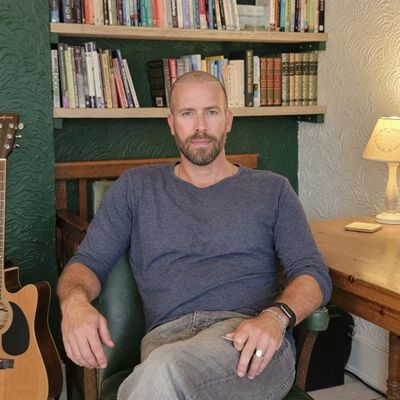
Steve Perkins is a psychotherapist and clinical supervisor in private practice in Shoreham-by-Sea and the City of London. Before training as a therapist he spent many years in banking and financial markets, including senior leadership roles.
He is the author of Moral Singularity and writes about moral closure, therapeutic enclosure, institutional culture, and the way beliefs form and harden inside social systems.
MBACP (Accred)